Monday, February 14, 2011

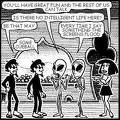
Illustration/Comic

An illustration is a displayed visualization form presented as a drawing, painting, photograph or other work of art that is created to elucidate or dictate sensual information (such as a story, poem or newspaper article) by providing a visual representation graphically.
Comics are a graphic mediumin which images convey a sequential narrative. The term derives from the mostly humorous early work in the medium, and came to apply to that form of the medium including those far from comic. The sequential nature of the pictures, and the predominance of pictures over words, distinguishes comics from picture books, though there is some overlap between the two.


Tuesday, February 8, 2011

Paul Jackson Pollock & Leonardo Da Vinci

Paul Jackson Pollock (January 28, 1912 – August 11, 1956), known as Jackson Pollock, was an influential American painter and a major figure in the abstract expressionist movement. During his lifetime, Pollock enjoyed considerable fame and notoriety. He was regarded as a mostly reclusive artist. He had a volatile personality, and struggled with alcoholism for most of his life. 


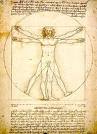
Leonardo has often been described as the archetype of the Renaissance man, a man whose unquenchable curiosity was equaled only by his powers of invention.[1] He is widely considered to be one of the greatest painters of all time and perhaps the most diversely talented person ever to have lived.

Da Vinci Seem to paint more life situations while pollock created more abstract peices.

Monday, February 7, 2011

line art and wassily kandinsky


Line art is any image that consists of distinct straight and curved lines placed against a (usually plain) background, without gradations in shade (darkness) or hue (color) to represent two-dimensional or three-dimensional objects. Line art can use lines of different colors, although line art is usually monochromatic.
Line art emphasizes form and outline, over color, shading, and texture. However, areas of solid pigment and dots can also be used in addition to lines. The lines in a piece of line art may be all of a constant width (as in some pencil drawings), of several (few) constant widths (as in technical illustrations), or of freely varying widths (as in brush work or engraving)
Wassily Kandinsky uses line art in various ways...it is very confusing. Geometrical elements took on increasing importance in his teaching as well as in his painting, particularly circle, half-circle, the angle, straight lines and curves. This period was a period of intense production. The freedom of which is characterised in each of his works by the treatment of planes rich in colours and magnificent gradations as in the painting Yellow – red – blue (1925), where Kandinsky shows his distance from constructivism and suprematism movements whose influence was increasing at this time.

Thursday, February 3, 2011

Frank Gehry


Frank Owen Gehry, CC (born Frank Owen Goldberg; February 28, 1929) is a Canadian American Pritzker Prize-winning architect based in Los Angeles, California.
His buildings, including his private residence, have become tourist attractions. His works are often cited as being among the most important works of contemporary architecture in the 2010World Architecture Survey, which led Vanity Fair to label him as "the most important architect of our age"
His works are interesting, i guess. :/

Wednesday, February 2, 2011

Definition Of Blueprint


A blueprint is a type of paper-based reproduction usually of a technical drawing, documenting an architecture or an engineering design. More generally, the term "blueprint" has come to be used to refer to any detailed plan.
Various base materials have been used for blueprints. Paper was a common choice; for more durable prints linen was sometimes used, but with time, the linen prints would shrink slightly. To combat this problem, printing on imitation vellum and, later, polyester film (Mylar) was implemented.

Light in Art.

Before the period of Renaissance, paintings hardly showed the concept of three-dimension give people a one flat plane feeling with several squeezed layers. There was no depth. Looking back, some of us would probably hardly be convinced that people before did not have the idea of the "space". They saw what was in front of their eyes, they painted it down simply being faithful to their eyes. The idea of three-dimensional space itself has been gradually evolved for thousands of years, men do not have it congenitally. There was no solid feeling therefore people didn't have a great emphasis on the light and shadow which are two essential elements forming gradation, creating the "space." 
There are many different example of light.
My favorite example occurs when lighting is used in photography because one different angle of light can create a seperate picture that another angle, even if they are a picture of the same object. 

Tuesday, February 1, 2011

Chinese Lantern Festival


The 15th day of the 1st lunar month is the Chinese Lantern Festival because the first lunar month is called yuan-month and in the ancient times people called night Xiao. The 15th day is the first night to see a full moon. So the day is also called Yuan Xiao Festival in China.According to the Chinese tradition, at the very beginning of a new year, when there is a bright full moon hanging in the sky, there should be thousands of colorful lanterns hung out for people to appreciate. At this time, people will try to solve the puzzles on the lanterns and eat yuanxiao (glutinous rice ball) and get all their families united in the joyful atmosphere.Until the Sui Dynasty in the sixth century, Emperor Yangdi invited envoys from other countries to China to see the colorful lighted lanterns and enjoy the gala performances.By the beginning of the Tang Dynasty in the seventh century, the lantern displays would last three days. The emperor also lifted the curfew, allowing the people to enjoy the festive lanterns day and night. It is not difficult to find Chinese poems which describe this happy scene.In the Song Dynasty, the festival was celebrated for five days and the activities began to spread to many of the big cities in China.Colorful glass and even jade were used to make lanterns, with figures from folk tales painted on the lanterns. 

I Think the lantern festival has some creative lanterns. Too bad we can't make these in our class :(